

Picture a second-floor apartment with a south-facing balcony. The tenant can’t put panels on the roof, and doesn’t want to anyway. But two panels on the railing, wired to a small microinverter and plugged into an outdoor outlet, could offset part of what their home office and refrigerator use during daylight hours.
That’s plug-in solar, and it’s a very different thing from the rooftop systems most people picture. A rooftop system is an engineered, multi-kilowatt installation with roof-mounted equipment, dedicated PV wiring, permits, inspections, and a utility interconnection agreement. Depending on the design, it may use a central string inverter or a microinverter at each panel. Plug-in solar trades all of that for a small, certified setup that connects through an outlet, which comes with its own rules around equipment certification and household circuits.
Both have a place. Here’s how they compare.
Getting installed
A rooftop project starts with a site assessment for roof condition and shading, then moves through structural and electrical design, permitting, installation, inspection, and utility approval before the system can turn on. Each step depends on local rules, and with thousands of jurisdictions and utilities across the country, timelines vary a lot.
Automated permitting has helped. When the National Laboratory of the Rockies (NLR, formerly NREL) reviewed SolarAPP+, it found qualifying permits were typically issued the same day, and projects passed inspection about 12 business days sooner than with traditional permitting. Rooftop solar is still a project measured in weeks, though.
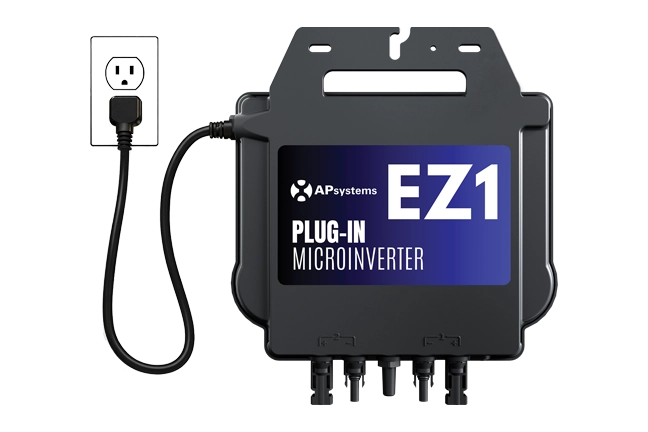
APsystems EZ1 plug-in microinverter
Setting up an APsystems EZ1 is a much shorter job. You mount one or two compatible panels on a railing, patio, or ground mount, connect their DC output to the EZ1, plug it into an approved outlet on a compatible circuit, and finish setup in the AP EasyPower app over the built-in Bluetooth and Wi-Fi. Beyond the microinverter, you’ll need the panels, mounting hardware, the right cables, and a suitable outlet. What that looks like depends on your space, and some sites still need electrical work. Nothing goes through the roof.
Rooftop systems fall under NEC Article 690, including the rapid shutdown rules in NEC 690.12. Those require rooftop systems to drop conductor voltage within seconds of shutdown so firefighters and other first responders aren’t working around live wiring.
Plug-in solar connects to ordinary household circuits, so the main worry is different. If an inverter kept producing power during a grid outage, it could energize lines utility crews expect to be dead. Equipment built for this use has to be certified for it.
The EZ1 is CSA certified to UL 3700, the standard developed specifically for plug-in PV systems, and meets UL 1741 SB requirements. Those certifications cover the EZ1 in its documented configuration with approved accessories. When the grid goes down, anti-islanding protection shuts the unit off, and it stays off until it has seen stable grid voltage and frequency for five straight minutes. Its DC side also runs below 60V, far lower than the string voltages on many rooftop systems. The manual’s connection and disconnection procedures still apply every time.

UL 3700 Certified
How much power you actually get
One EZ1 handles one or two panels and puts out up to 900W AC. For our balcony tenant, that’s enough to offset part of what a fridge, a laptop setup, or a window AC unit uses while the sun is up. It won’t come close to a full-size array, and it isn’t meant to.
For more output, APsystems documents a two-unit setup. An approved dual parallel bus cable connects two EZ1s for up to 1,800W combined on a suitable 15A circuit, according to APsystems’ current training materials. Beyond that, you’re outside the documented configuration, and spreading extra units across outlets around the house isn’t a workaround. That kind of expansion needs a real review of your circuits, service capacity, code, and utility rules.
Rooftop systems don’t run into those per-circuit limits because they’re built as multi-kilowatt installations with their own interconnection from day one. On roofs with several orientations or partial shade, microinverters like APsystems’ broader lineup let each panel produce on its own terms.
What it costs
A straight price comparison doesn’t say much without knowing the equipment, panel wattage, labor rates, and what you pay for electricity. By category, it looks like this:
Cost category |
Plug-in solar |
Traditional grid-connected solar |
| Hardware | Certified plug-in microinverter, one or two panels, approved cables and mounting | Full array, inverter equipment, racking, wiring, and required safety equipment such as rapid shutdown |
| Installation | Designed for simplified installation where permitted; electrical work may still be needed | Professional design and installation |
| Permitting | Varies; may be simpler where a plug-in solar pathway exists | Generally requires building and/or electrical permits |
| Utility requirements | Vary by jurisdiction, configuration, and export rules | Generally requires a utility interconnection process |
| Additional equipment | APmeter when zero-export control is needed or preferred | Storage, monitoring, and other project-specific equipment |
On incentives, the federal Residential Clean Energy Credit (Section 25D) offered 30% on qualifying residential clean energy expenditures through December 31, 2025. Under current federal law, it isn’t available for new expenditures after that date. State, local, and utility programs may still help. Their rules vary, so check the program details or ask a tax professional.
Payback is measured differently, too. A rooftop system is usually judged by how much of the home’s total electricity use it offsets. A plug-in system’s payback depends on your local rates and how much of its output you use right when it’s produced.
Before you buy: the rules that apply
Most of the fine print for plug-in solar lives here.
Start with your state, your utility, and your local Authority Having Jurisdiction (AHJ). Some allow plug-in solar on a standard outlet with little or no process. Others require a dedicated circuit or a permit no matter how small the system is. Even where it’s allowed, household circuits have load and backfeed limits that cap how much generation they can safely carry.
Property rules are a separate question. A lease can require landlord permission for railing attachments, wiring, or visible panels, and HOAs and condo associations often have restrictions of their own.
If your utility restricts power flowing back to the grid, the optional APmeter can help. It monitors power at your electrical panel and adjusts EZ1 output automatically so nothing is exported. It doesn’t replace permitting, utility notification, or interconnection requirements, so you still need to confirm the installation is allowed.
And if you’re hoping for backup power, the EZ1 isn’t it. It’s grid-tied and shuts off during outages by design. It shouldn’t be connected directly to a battery, and it belongs on a non-backup outlet unless APsystems documentation specifically approves another setup.
Which one fits you
For renters, condo residents, and anyone without usable roof access, plug-in solar may be one of the easiest ways to make power at home (community solar is another option to compare). The EZ1 was designed for exactly these situations.
Homeowners who want to offset a large share of their annual electricity use will generally need a full-size rooftop or ground-mounted system. Plug-in solar can’t scale to that through household outlets.
Some homeowners split the difference. They start with an EZ1 on a sunny patio, watch real production numbers in AP EasyPower, and use that data to size a rooftop system later. Keeping the EZ1 running after the rooftop system goes in is possible, as long as it fits your interconnection agreement, approved system capacity, and circuit requirements. If battery storage and a backup subpanel are part of the picture, APsystems recommends putting the EZ1 on a non-backup outlet.
A few questions to ask yourself:
- Do you have a sunny spot off the roof, like a balcony, patio, garden, fence, or yard?
- Is there a suitable outlet and circuit near it?
- Are you after supplemental generation, or trying to cover most of your home’s usage?
- Have you checked with your utility, AHJ, and landlord or association?
- Would simple production monitoring in an app be enough?
The balcony tenant from the beginning checks nearly every box for plug-in solar. A homeowner with a big roof and a big electric bill checks almost none of them. Most people land somewhere in between, and the answers above will usually tell you which way to lean.
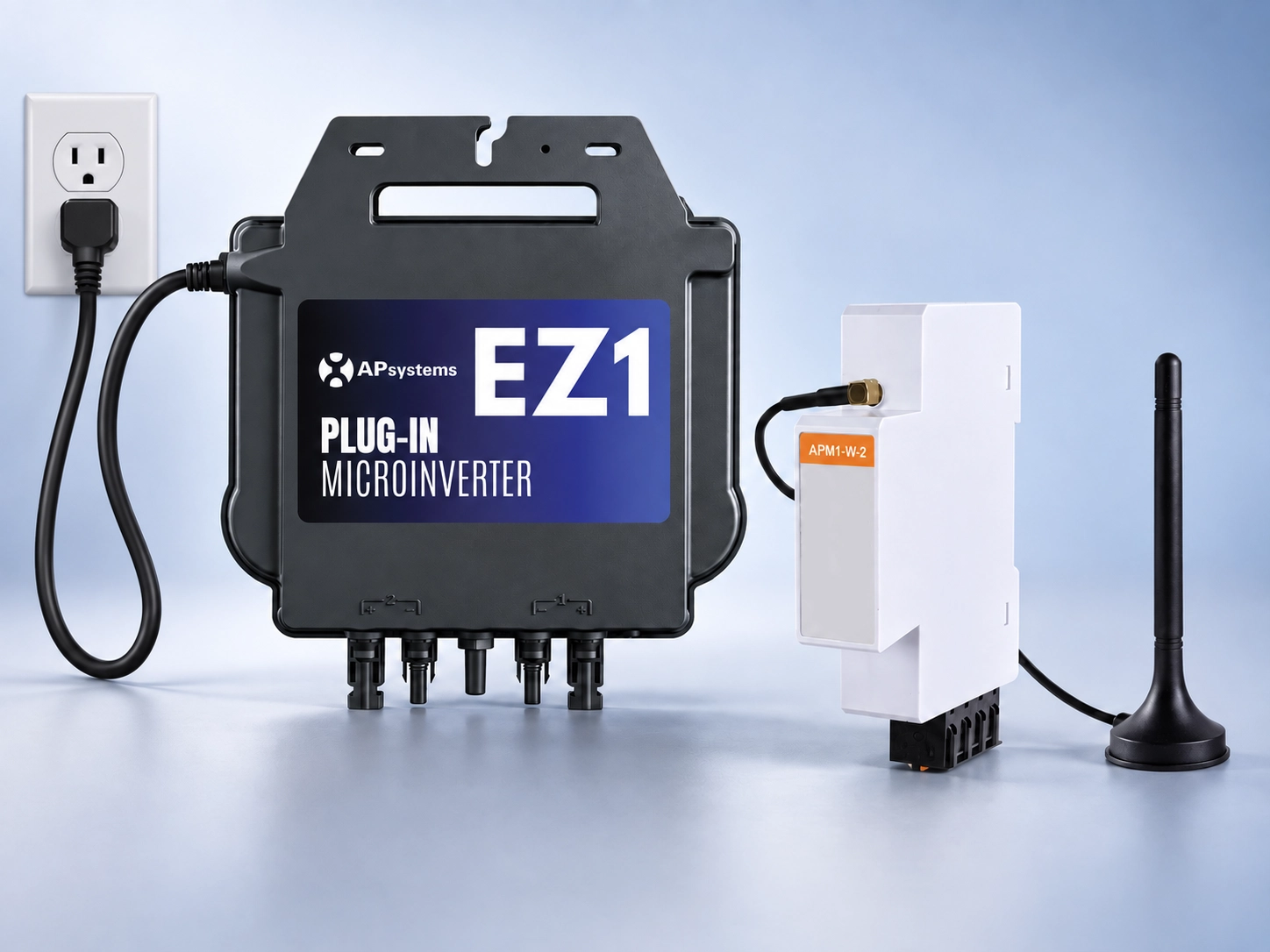
APsystems EZ1 plug-in microinverter and APmeter for zero export